
TL;DR: Pairwise comparison-based ranking reflects the accuracy-based ranking of models on verifiable tasks.
Motivation
When we evaluate large language models, we often care about ranking them in one way or another. If the task is well-defined and we have ground truth labels, we can rank them by accuracy, which reflects how well they perform on the task. However, benchmarks measuring accuracy are not our only option for ranking models. In Chatbot Arena1 models are evaluated on a diverse set of open-ended tasks using pairwise comparisons. The concern is that pairwise judgments are heavily biased to select the output that appears to be correct rather than selecting the output that is correct 2345. So the question arises:
Can pairwise comparison-based ranking reflect task performance?
We set out to answer this question by applying pairwise comparisons on a range of benchmarks, and checking whether the resulting ranking aligns with the accuracy-based ranking of the models.
What we found
- High alignment with accuracy-based ranking: high rank and score correlation across 5 benchmarks.
- Outperforms baseline in weak model setting: using a weak model (a model that’s not good at the task) directly as a judge (LLM-as-judge) is significantly worse than using it to collect pairwise comparisons.
- Rankings robust to judge biases: correcting for style 23 and self-preference bias 4 had minor impact on the ranking.
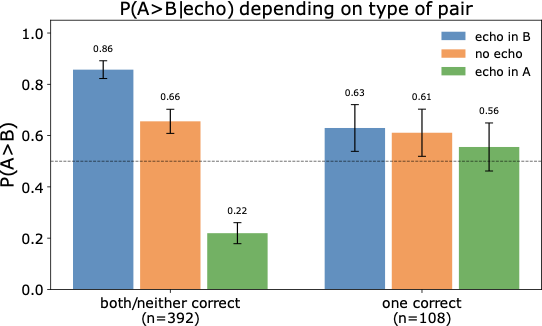
- Echo influences judgment on non-discriminative pairs: on pairs where both candidate answers are correct (or both are incorrect), the judge tends to choose answers that do not have any sequence repetition (echo).
Main results
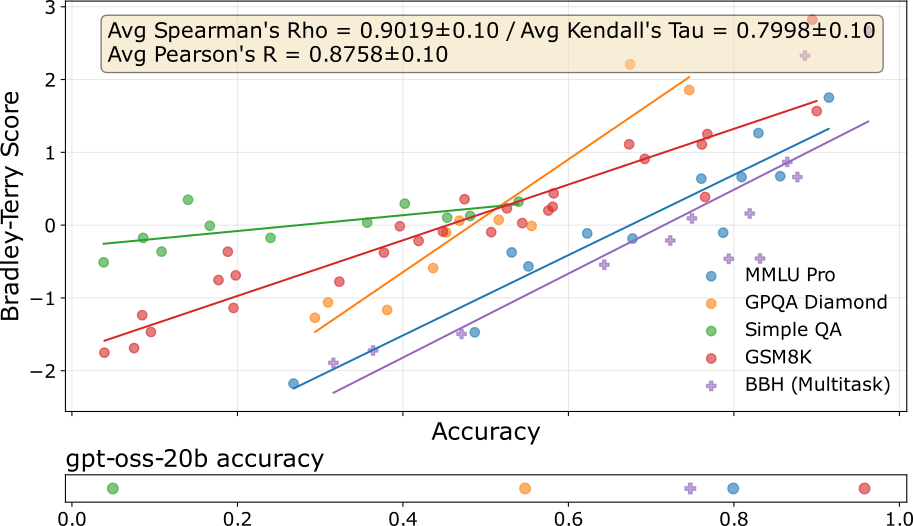
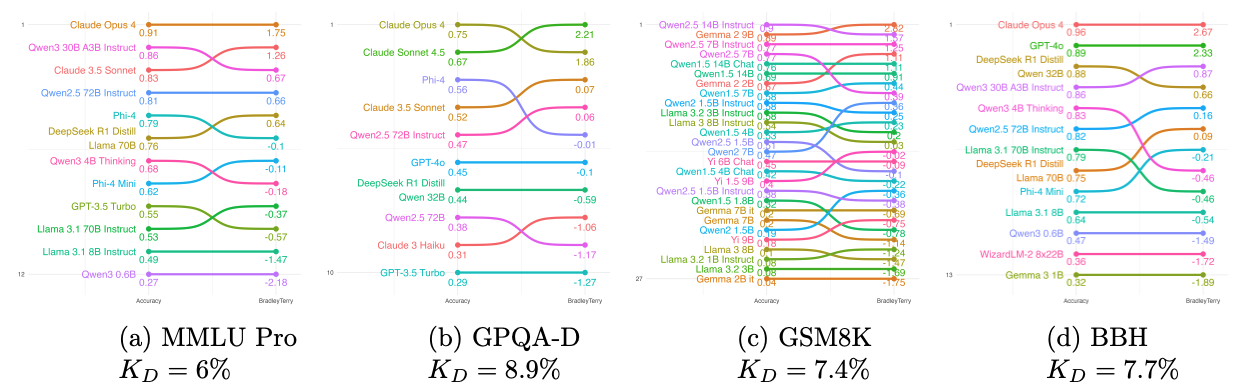
Preference-based rankings align closely with accuracy-based rankings across all five benchmarks. We observe both high rank correlation (\(ρ > 0.9\)) and high score correlation (\(r > 0.87\)) across all judge models. What this means in practice is that
on 4 out of 5 benchmarks, only 6-9% of model pairs need to be swapped to recover the accuracy-based ranking.
Direct Judge Baseline
Is it better to use the model directly as a judge?
A natural alternative to pairwise comparisons is to use the judge to directly classify each answer as correct or incorrect — this is what we call the Direct Judge baseline. This is a strictly harder task: the judge must assess answers in isolation, without the relative signal a comparison provides. A weak judge that struggles with individual classification may still reliably pick the better of two answers. When the selected judge does well on the task, both the Bradley-Terry and the Direct Judge approach perform well. However,
when the judge is weak, the Direct Judge doubles the rank distance on SimpleQA (\(K_D=0.2 \rightarrow 0.382\)).
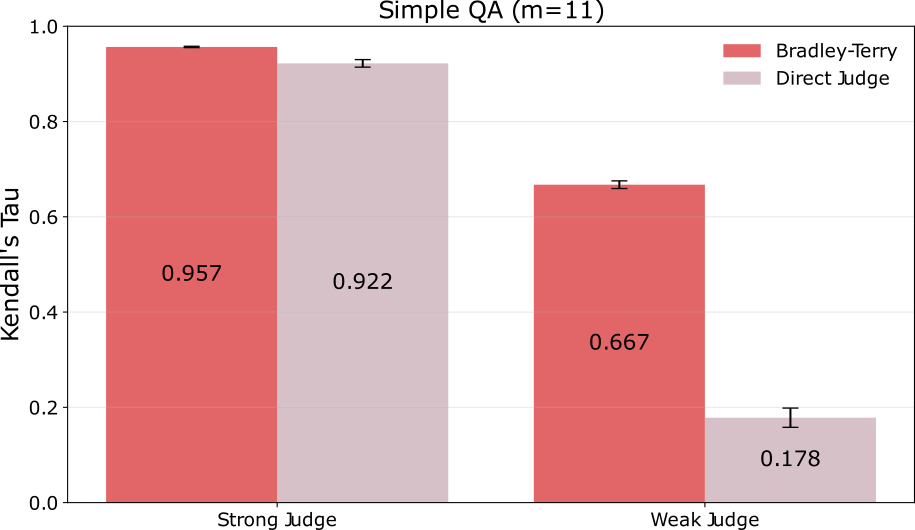
In other words, Bradley-Terry outperforms the Direct Judge when the judge model has low accuracy on the task. This robustness may prove useful in frontier settings, where it’s difficult to say whether the selected judge is “weak” or “strong”.
Judge bias
Does rank correlation improve after bias correction?
Style and self-preference biases are well-documented in pairwise evaluation — judges tend to favour longer, more formatted answers (style bias), or outputs from their own model family (self-preference bias). While such biases may affect absolute scores, their effect on relative model rankings is less clear. We corrected for both and found that
bias correction has a minor effect on rank correlation.
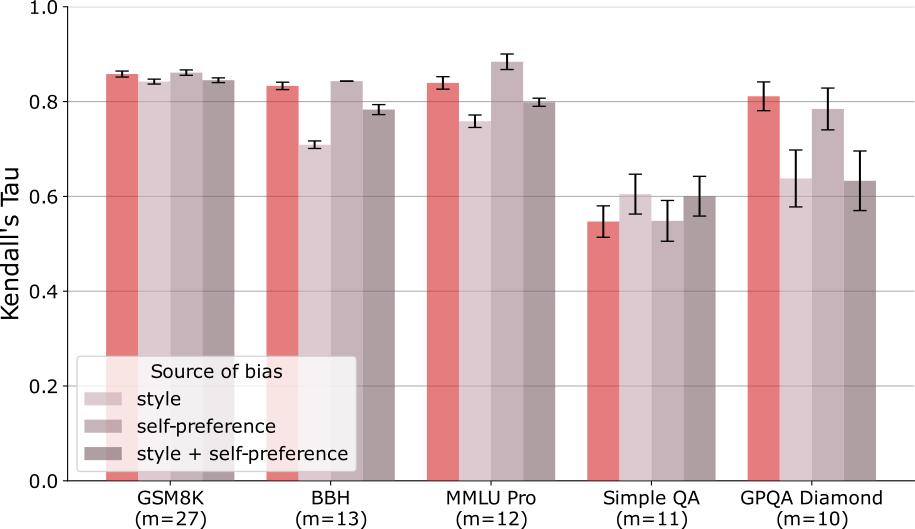
Importantly, this does not imply the absence of bias — only that such biases have limited impact on model ranking in our evaluation.
Echo
What drives the signal in non-discriminative pairs?
On 60% of pairs, correctness provides no discriminating signal. We call these non-discriminative pairs, where both answers are either correct or incorrect. The judge has to rely on superficial cues. And yet, we find that on such pairs rank correlation is still surprisingly high. One strong cue we identified is echo: a failure mode where a model fails to stop after its final answer and repeats content, such as phrase or sequence repetition.
We found echo to be a causal driver of judge preference: \(P(A>B)\) drops from 0.81 to 0.29 (\(\Delta=−0.52\)) depending on which answer has echo. This effect disappears on discriminative pairs (\(\Delta=−0.07\)).
Closing thoughts
Of course, it’s important that our model rankings are not influenced by subjective biases. On questions where some answers are objectively better, we found that pairwise comparisons (and the resulting rankings) often indeed reflect the objective choice (picking the model with higher accuracy). This means that on discriminative pairs the judge picks the correct answer. On pairs where this objective choice is not possible, however, the judge falls back to appearance-based cues — it avoids picking answers that contain echo — which are also correlated with higher model accuracy. This doesn’t mean the biases can be ignored: they could still be exploited adversarially to inflate a model’s ranking.
Acknowledgements
Cover image source. Drawing by Mariano Salvador Maella.
-
W. Chiang, L. Zheng, Y. Sheng, et al. “Chatbot Arena: An open platform for evaluating LLMs by human preference.” ICML 2024. ↩
-
Y. Dubois, P. Liang, T. Hashimoto. “Length-controlled AlpacaEval: A simple debiasing of automatic evaluators.” ICML 2024. ↩ ↩2
-
T. Li, A. Angelopoulos, W. Chiang. “Does style matter? Disentangling style and substance in Chatbot Arena.” LMSYS Blog, 2024. ↩ ↩2
-
K. Wataoka, T. Takahashi, R. Ri. “Self-preference bias in LLM-as-a-judge.” NeurIPS Safe Generative AI Workshop, 2024. ↩ ↩2
-
G.H. Chen, S. Chen, Z. Liu, F. Jiang, B. Wang. “Humans or LLMs as the judge? A study on judgement bias.” EMNLP 2024. ↩